The Relationship Between Parents and Youth Sports

Youth sports in the United States have evolved into a cultural phenomenon where the competitive spirit extends far beyond the playing field. Parents’ behaviors, ranging from irrational spending to aggressive conduct, have become emblematic of the deep emotional and social investments tied to their children’s participation in sports.
This phenomenon can be understood through the lens of what I term the “Veblen Goods Syndrome,” where youth sports represent a modern-day equivalent to luxury items, driven by status and societal pressures.
Lets dive in....
What drives spending behavior in Youth Sports?
Traditional economic theory suggests that demand decreases as price increases, a principle known as the law of demand. However, Veblen goods, named after economist Thorstein Veblen, defy this norm. These goods derive their value not solely from their utility but from their ability to signal wealth, success, or prestige. Classic examples include luxury cars, designer handbags, and high-end watches—products that become more desirable as their price rises, precisely because they signal exclusivity.
Youth sports, surprisingly, mirror this dynamic. Parents often view their children’s participation in elite teams, clubs, and tournaments as a status symbol. (although few will ever admit this)
Higher team dues, expensive travel, and exclusive training programs signal a level of dedication, talent level and even affluence that many parents are eager to display.
These 3 currencies are in abundance at nearly all levels of youth sports. Don’t believe me? then ask yourself when the last time was that a conversation happened between parents debating the relative qualities of the leagues, coaches, or teams? How many times have you laughed under your breath at the absurdity of a remark made where a parent tries to convince the listening audience of the unassailable qualities of said league or team?
The irony is that as costs rise, so too does the willingness of parents to pay, illustrating the same counterintuitive demand pattern seen in traditional Veblen goods.
Evidence of the Syndrome: Spending Trends and Behavioral Patterns
Michael Lewis’s book Playing to Win provides a compelling example of this phenomenon during the COVID-19 pandemic. Despite economic uncertainty and widespread disruptions to daily life, parents of youth athletes were quick to pay their sports tuition—often faster than in pre-pandemic times. This behavior suggests that the financial commitment to youth sports transcends rational decision-making and is tied to deeper psychological and social factors.
But spending is only one facet of the irrationality. The emotional investments parents make in their children’s athletic endeavors often translate into extreme behavior. Stories of parents berating coaches, clashing with referees, or engaging in verbal altercations on the sidelines are disturbingly common.
These actions reflect the high stakes parents associate with youth sports, where their child’s performance is perceived as an extension of their own identity and social standing.
The critical thinking and thoughtful human is replaced by unhinged emotion - a momentary psychosis of sorts that most would never dream of displaying in their professional or social lives. These behaviors are worryingly ubiquitous, and serve only to embarrass and shame a child who is now being taught something he or she was not born with, but will likely repeat later in their lives.
The Root Causes of “Veblen Goods Syndrome” in Youth Sports
Several factors contribute to this phenomenon of sorts:
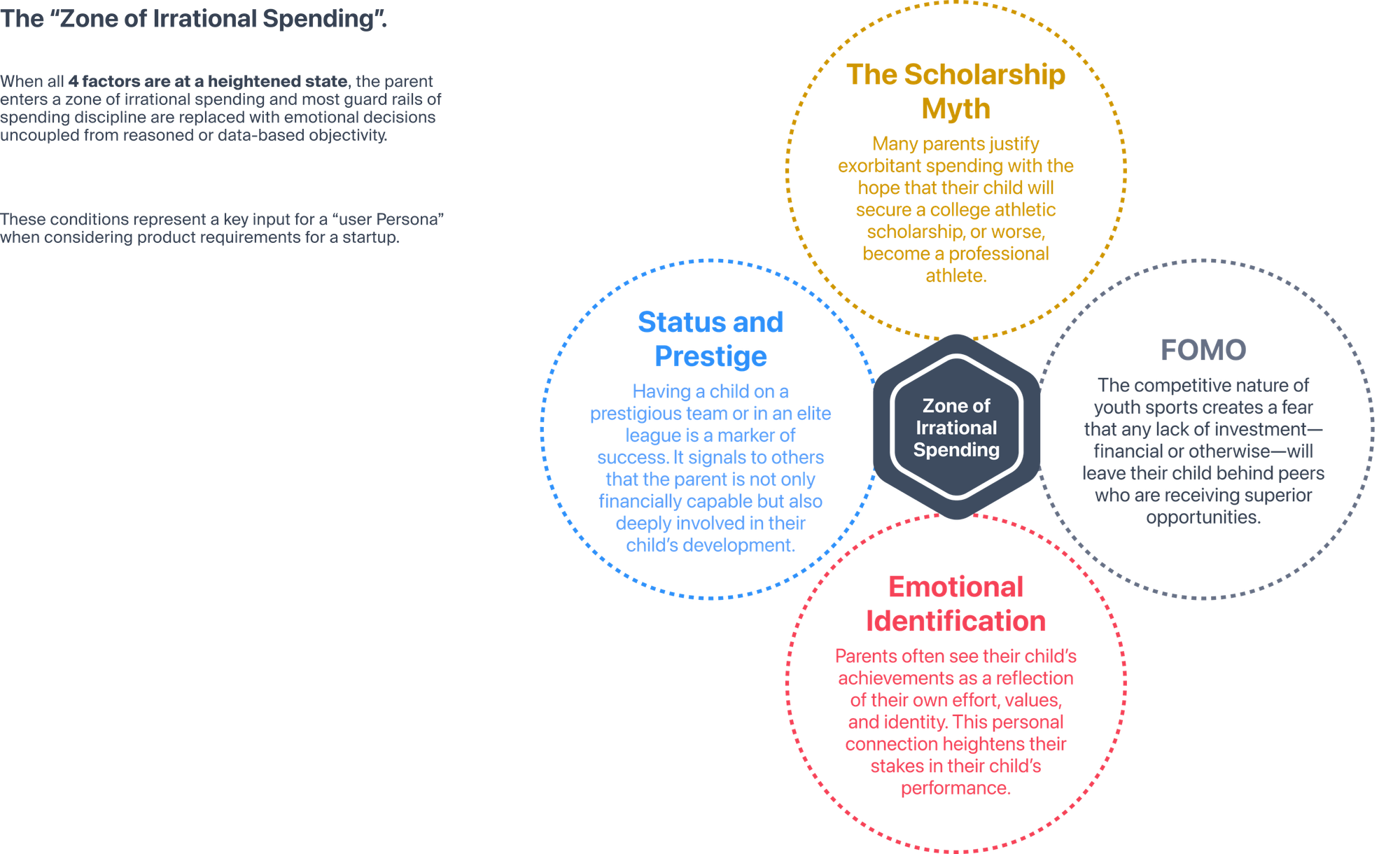
- Status and Prestige: In many communities, having a child on a prestigious team or in an elite league is a marker of success. It signals to others that the parent is not only financially capable but also deeply involved in their child’s development. It even speaks to a darwinistic urge to assert a sort of place at the top of the food chain. No one would admit this however.
- Aspirations and the “Scholarship Myth”: Many parents justify exorbitant spending with the hope that their child will secure a college athletic scholarship, or worse, become a professional athlete. While statistically improbable for most athletes, this belief fuels an irrational willingness to invest. Indeed the data confirms that nothing is further from the truth. Scholarship numbers have not moved one fraction of a % for decades, save for the long-overdue gender based changes of recent years.
- Emotional Identification: Parents often see their child’s achievements as a reflection of their own effort, values, and identity. This personal connection heightens their stakes in their child’s performance.
- Fear of Missing Out (FOMO): The competitive nature of youth sports creates a fear that any lack of investment—financial or otherwise—will leave their child behind peers who are receiving superior opportunities.
Clouds Are Forming for Parents of Youth Sports Athletes
Youth sports, once a pillar of community engagement and child development, are increasingly dominated by rising costs and private equity interests. As tuition fees surge and financial pressures mount, families are left grappling with a system that feels less about nurturing talent and more about maximizing profit.
Widening Access Divide: A System of Exclusion
Rising participation costs are creating a troubling divide in youth sports, where access is determined by financial means rather than talent or effort.
- Data Insight: The Aspen Institute reports that the average cost of participating in youth sports rose to $693 annually in 2023, with sports like ice hockey ($2,583) and gymnastics ($1,580) far exceeding this average. Travel sports teams push these figures even higher, often exceeding $10,000 annually per child.
Families from disadvantaged backgrounds face increasing ostracization, as they are unable to afford the rising costs of club fees, equipment, travel, and tournament entry. This disparity denies countless talented athletes the chance to compete and grow, eroding the inclusivity that should define youth sports.
Private Equity’s Influence: Profits Over Purpose & How Private Equity is Reshaping Youth Sports
Private equity firms have identified youth sports as a lucrative investment sector, targeting everything from local clubs to major leagues and tournament management companies. The influx of capital brings promises of professionalization but often results in higher costs and diminished value for families. The following dynamics are impacting the marketplace.
- Tuition Hikes:
After acquisitions, programs frequently increase tuition to generate immediate returns for investors.
- Example: A leading New England soccer club, acquired by a private equity-backed group in 2022, saw tuition fees rise by 30% within a year, despite no noticeable improvement in coaching or facilities.
- Cost-Cutting Measures:
To improve profitability, acquired programs often reduce spending on coaching quality, facility upgrades, or player development resources.
- Focus on Cash Flow, Not Product Quality:
Private equity strategies prioritize predictable cash flow. This means more emphasis on standardization and cost efficiency rather than innovation or meaningful enhancements to the player experience.
Statistic: According to a Deloitte report on sports investment, youth sports companies backed by private equity tend to prioritize operational efficiency, often at the expense of community engagement and inclusivity.
The Bigger Picture:
Private equity's increasing dominance in youth sports is part of a broader trend, with firms investing in everything from tournament organizers to software providers. While this capital injection might lead to short-term gains for some organizations, the long-term impact often leaves families paying more for less.
It should be said that the quality of product today (I speak from direct experience in both Soccer and Hockey) is extremely unpredictable and almost entirely comes down to the quality of the coach and not the program. Further, the coach is often volunteering!

Conclusion
The intersection of parents’ behaviors and youth sports reveals a fascinating dynamic where status, emotion, and economics collide. The willingness to spend—and even behave irrationally—in support of their children’s athletic pursuits underscores the powerful influence of the “Veblen Goods Syndrome.” Recognizing this phenomenon not only sheds light on the culture of youth sports but also opens the door for innovative approaches to serve this uniquely motivated market.