From Cave Walls to Expressive Commerce — A Manifesto for Human Creativity and the Next commerce Medium
Through that lense, a visual creative canvas must take a place of prominence and become the creative plane. Chat and prompting does have a role. They become the memory and control plane. The user can still express anything and the system routes this intent.

Human beings have told visual stories for at least 40,000 years. We didn’t begin for entertainment—we began to survive, coordinate, belong, and matter. Long before galleries, brands, or media industries, humans marked surfaces to signal presence, identity, affiliation, and intent. The first images on cave walls were not made to be admired centuries later. They were made to be seen, understood, and acted upon.
Creativity, from the beginning, was expression with consequence.
Creativity Was Never Separate from Exchange
The modern separation between creativity and commerce is a historical anomaly. For most of human history, expression was inseparable from use, exchange, and circulation.
As societies formed, creativity moved off walls and into the world as material culture. Clothing signaled identity. Symbols marked ownership. Crafted objects carried stories. Decoration increased desirability. To create was to modify matter—to attach meaning to objects that could be worn, shared, displayed, or exchanged.
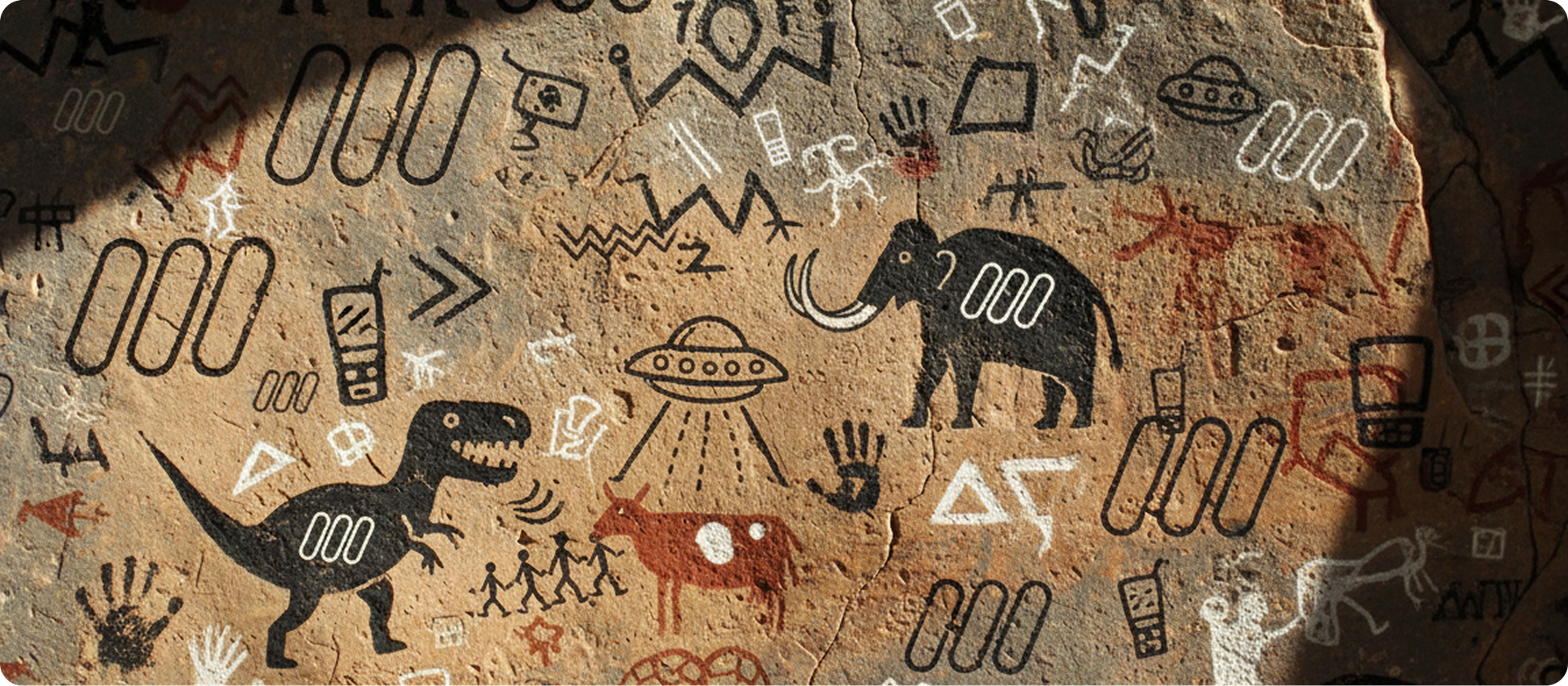
This was not incidental. Embodied expression persisted longer, traveled farther, and coordinated social life more effectively than ideas that remained abstract. Creativity gained power through use, adoption, and circulation. Symbols that were taken up endured. Designs that were copied spread. Objects that were exchanged carried meaning across time and groups.
Validation came not from passive admiration, but from participation.
The Industrial Detour
The industrial era introduced a rupture. Mass production demanded standardization and planning, pushing expression upstream into design and marketing while commerce moved downstream into distribution and sales.
Creativity became representational rather than embedded. Products were manufactured first and imbued with meaning later. This separation increased efficiency—but it slowed culture. By the time an idea became a product, the moment that inspired it often no longer existed.
Creativity and commerce still depended on each other. They simply stopped moving together.

Digital Culture Begins to Close the Gap
Digital tools started repairing the split. Memes turned expression into currency. Social feeds made visibility transactional. Drops replaced catalogs. Remix culture blurred authorship. Identity and product remerged.
Expression accelerated dramatically—but one friction remained.
Turning expression into a sellable object still took too long.
Ideas could spread instantly. Products could not. Creation sped up. Commerce lagged behind. This lag defined the limits of digital creativity.
Why Prompts and Chat can Miss the Moment
Most AI creativity today flows through chat interfaces and prompting. This assumes creativity is linguistic, reflective, and sequential.
Human creative impulse is not.
It is visual, immediate, contextual. Stopping to explain intent interrupts it. Prompting translates impulse into language. Translation introduces delay. Delay kills relevance and encourages fixation.
The next creative medium we hope to build cannot require creators to pause before they act. Instead it must collapse the creative impulse into a payload for commerce.
Through that lense, a visual creative canvas must take a place of prominence and become the creative plane. Chat and prompting does have a role. They become the memory and control plane. The user can still express anything and the system routes this intent.
Examples:
Operational:
“save this for later”
Commercial:
“what’s the cheapest option?”
Logistical:
“can I ship this to Europe?”
Creative:
“add a cave wall background in gray high contrast”
The system routes intent:
- Creative → affects the canvas (creates a branch) and changes the visual display (card)
- Non-creative → answered in the chat feed only.
The Collapse: Expression, Product, Transact
We are entering a new phase where the loop fully collapses. This must instantiate in an interface that goes far beyond prompting.
Ephemerality Is a Feature
In expressive commerce, products are allowed to disappear. Moments are allowed to pass. Relevance is time-bound. Scarcity comes from context, not supply.
Permanence is optional.
Timing is essential.
Meaning is proven through participation, not preservation.
What We Mean by Expressive Commerce
Expressive commerce is a creative medium in which expression, product creation, and exchange collapse into a single act. It allows ideas to become embodied objects instantly, and for those objects to be shared, remixed, and transacted without leaving the creative flow. In expressive commerce, selling is not a downstream outcome—it is immediate validation. Meaning is not preserved through permanence, but proven through participation.
Back to the Beginning, at the Speed of Culture
Human creativity began as expression with consequence—not abstracted, deferred, or archived. Generative technology doesn’t invent a new impulse. It restores an old one at the speed of now.